Their priciest piece cost S$3,000. Then a judge asked why they weren't selling abroad
Afzal Imram and Lin Ruiyin funded their first jewellery collection with branding work. The hard part was never the design. It was the price.


A 6-minute read.
In 2015 the most expensive thing Afzal Imram and Lin Ruiyin had ever made cost about S$3,000, and asking anyone to pay it felt presumptuous. Their jewellery has since been worn by Rihanna, Michelle Obama and Taylor Swift, and sits in roughly twenty shops outside Singapore.
🎬 The Story
| Founder | Afzal Imram and Lin Ruiyin |
| Location | Singapore |
| Started | 2015 (first collection); their design studio Proper People from 2014 |
| Bootstrapped? | Yes. The first collection was paid for by branding and design consulting sold through Proper People, still the registered company the brand operates from |
| Revenue (source) | not disclosed — Vulcan Post, May 2026 |
Facts below come from interviews with Vulcan Post (25 May 2026) and Vogue Singapore (10 October 2025), unless noted. The brand is State Property.
They met around 2010 through mutual friends. He was reading industrial design at NUS, she was at Central Saint Martins in London studying jewellery design, and when he went on exchange to Paris they began working on each other's projects. The division of labour held: architecture and geometry from him, the jeweller's hand from her.
Out of university in 2014, with no employer, they set up a design consultancy called Proper People and sold branding work to other businesses. It is still the registered company State Property operates from, it still handles the brand's own identity, and it paid for the first collection.
Before that collection there was an unbranded bespoke service, and it set the direction. "What we saw was that a lot of clients were asking us to replicate Tiffany pieces or pieces from the big houses," Ruiyin told Vogue Singapore. Copying paid, and it left them anonymous. The 2015 collection was the answer: fine jewellery made the wrong way round, where the idea comes first and the stone is chosen to serve it, instead of a beautiful stone with a setting built around it.
Pricing was the part they could not solve. The best pieces in that first collection went for around S$3,000. "Asking someone to pay S$3,000 for our work? Who wants to spend that here?" Afzal remembers thinking. They looked for peers at that price and found almost none. "We looked up," he said, "and felt really alone."
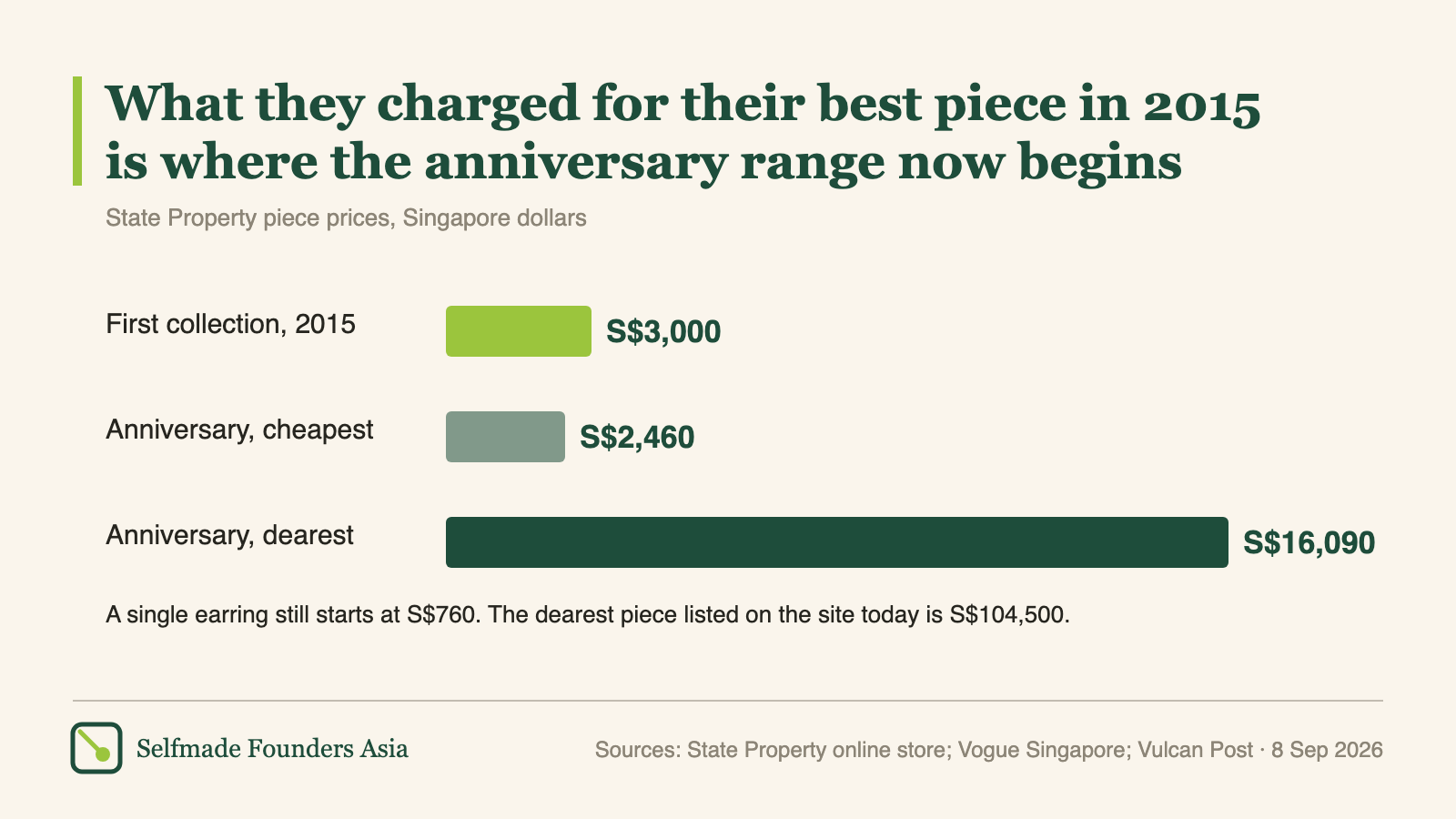
The unlock came from a stranger. In 2017 State Property won Emerging Accessories Designer of the Year at the Singapore Fashion Awards. One judge was Tina Tan-Leo, a retailer who spent a career bringing international labels to Singapore. "She basically said, 'Guys, your stuff is good to go international. Why aren't you there?'" Afzal recalled. Tan-Leo mentored them for six months, reworked the pricing, wrote down how to export, and introduced them to independent designer jewellers elsewhere. The United States came first, the Middle East a couple of years later. In 2018 Nicole Kidman wore their earrings to a film premiere, the first famous name to do so. In 2021, Vulcan Post reports, State Property became the first Singaporean fine jewellery label stocked by Net-A-Porter.
The making is split by technique, not cost: workshops in Hong Kong, Sri Lanka and Italy, diamonds cut in India, coloured stones from Sri Lanka and Brazil. On a commission built around a client's own stone, the final setting is done in Singapore, where the founders can watch it.
The other thing that moved the business was rent. For years discovery ran on word of mouth, Instagram and appointments. They opened an atelier on Armenian Street in early 2021 and a boutique in Takashimaya Shopping Centre in September 2022, pushed into it by Afzal's brother, who had come back from Indonesia to run the numbers. "He pushed us to do this mall thing because the rent scared us," Ruiyin told Vogue Singapore. Local and international sales used to be roughly even. Singapore is now the larger half.
The team is about ten people and much of it is family: the brother on finance, a sister-in-law on retail partnerships, a childhood friend of Ruiyin's on manufacturing. Buyers are mostly in their late thirties and forties and already own Cartier or Van Cleef. "In some ways, our inexperience gave us freedom," Ruiyin told Tatler Asia last September. "We didn't know the rules well enough to feel afraid of breaking them."
The takeaway
- A price is a decision, not a reward for seniority. Their ceiling did not lift because the craft suddenly improved. It lifted when somebody who knew the export market told them what the work was worth outside Singapore.
- Fund the brand with the skill next door. Branding consultancy paid for collection one, and it is still the company the brand sits inside.
- Some things only rent can buy. Six years of Instagram and private appointments never produced what a mall shopfront did, and the person who saw it was the one reading the accounts.
🌏 Around the Region
- Indonesia: Tona's Coffee, run by the Arjuna Farmer Group in Lembang, West Java, made its first export in August: four tonnes of pineapple-fermented Arabica to Riyadh, worth about Rp800 million. The buyers had asked for 25 tonnes. "Our primary obstacle is the availability of raw materials," manager Dikdik Ramdaniansyah told Antara (31 August 2026). Japan is next year's target.
- Malaysia: SkyeChip, a chip-design firm that only began operating in 2020, listed on Bursa Malaysia's Main Board in May and reported RM155 million of revenue for FY2026. Of its 391 staff, 365 are engineers. Co-founder Fong Swee Kiang wants to build the Broadcom of Malaysia, not fight Nvidia, per Digital News Asia (7 September 2026).
- Korea: Kakao Ventures opens Temp Seoul this month, a residency for solo founders named after the /tmp directory in Unix. Residents build in one room for a fixed spell and present at a Friday "Ship Night". Seoul Economic Daily (19 August 2026).
- Philippines: TikTok Shop says orders in the Visayas and Mindanao rose 140 percent in the year to July 2026, sellers 50 percent and creators 160 percent. Its training programme with the trade department has reached more than 35,000 small firms, reports The Freeman (1 September 2026). The figures are the platform's own.
Last week: a school dropout who built Singapore's drainage business for the big food chains. The full archive is at founders.selfmademodal.com.
Forwarded this by a friend? Subscribe here. Found it useful? Forward it to one person who'd want it.
Know a builder who deserves the spotlight? Tell us, reply to this email.
— The Editorial Team