He dropped out to clean grease traps. Now every Starbucks in Singapore calls his crew
Shaik Nifael failed his O-Levels and started at the bottom of Singapore's drainage trade. Jetters Incz now keeps the pipes clear for the big food chains.


A 6-minute read.
Shaik Nifael's first job, at 17, paid S$23 a day for cleaning the grease traps under Singapore's kitchens. Twenty years later his company keeps the drains flowing for every Starbucks in the country, and he still takes the 3AM emergency calls himself.
🎬 The Story
| Founder | Shaik Nifael |
| Location | Singapore |
| Started | August 2015 |
| Bootstrapped? | No. S$200,000 from one private backer, landscaping owner Kelvin Neo, in 2015; no venture money since |
| Revenue (source) | Just under S$3 million in 2025 (company figure via Vulcan Post, Aug 2026) |
Every fact below comes from Shaik's profile in Vulcan Post (26 August 2026) unless we say otherwise. The company is Jetters Incz, a drainage and waste-management firm with 12 people and seven vehicles. "Who really wants to clean longkang?" Shaik asks, using the local word for a storm drain. That, it turns out, is the whole point.
School was not going to work. He failed O-Level maths and combined science and left Millennia Institute after his first year. His father, a general manager at a waste-management company with 40 years in the trade, gave him a choice: go back to school, or come and earn your keep. "I wanted to prove myself to him, so I took up the challenge," he said. "I went to my father's office for the interview the very next day."
In 2011 he joined a rival firm, run by a friend of his father, as a management trainee. He learned to read a blockage, open a pipe and clear a choke, helped grow the fleet from three vehicles to 17 in four years, and became operations manager. In late 2014 an acquaintance, Kelvin Neo of landscaping company Ho Eng Huat Construction, offered to back him if he ever went out on his own. Shaik said no; he liked the job. Then his father and the owner fell out, and within nine months Shaik was out too. He called Kelvin back.
He did not bring a pitch deck. He brought a line-by-line budget for vehicles, licences and tanker fabrication, and asked for S$200,000. Kelvin barely looked at it. Jetters Incz opened in August 2015 with second-hand desks and chairs from Carousell, "a Frankenstein office, cut and paste, enough to get it going." His wife Dania ran sales from day one while raising their children. First-year sales came to S$600,000, mostly from clients who followed him on trust alone.
The work is unglamorous and precise. Shaik likens a building to a body: the pipes are arteries, and Jetters is the doctor who clears the blockage before the burst. Most jobs are scheduled rotations, every outlet under contract visited before anything goes wrong. The rest is emergencies: a flooded kitchen line at midnight, two or three men on site until 3AM, another crew out by morning. He and Dania take turns on the hotline.
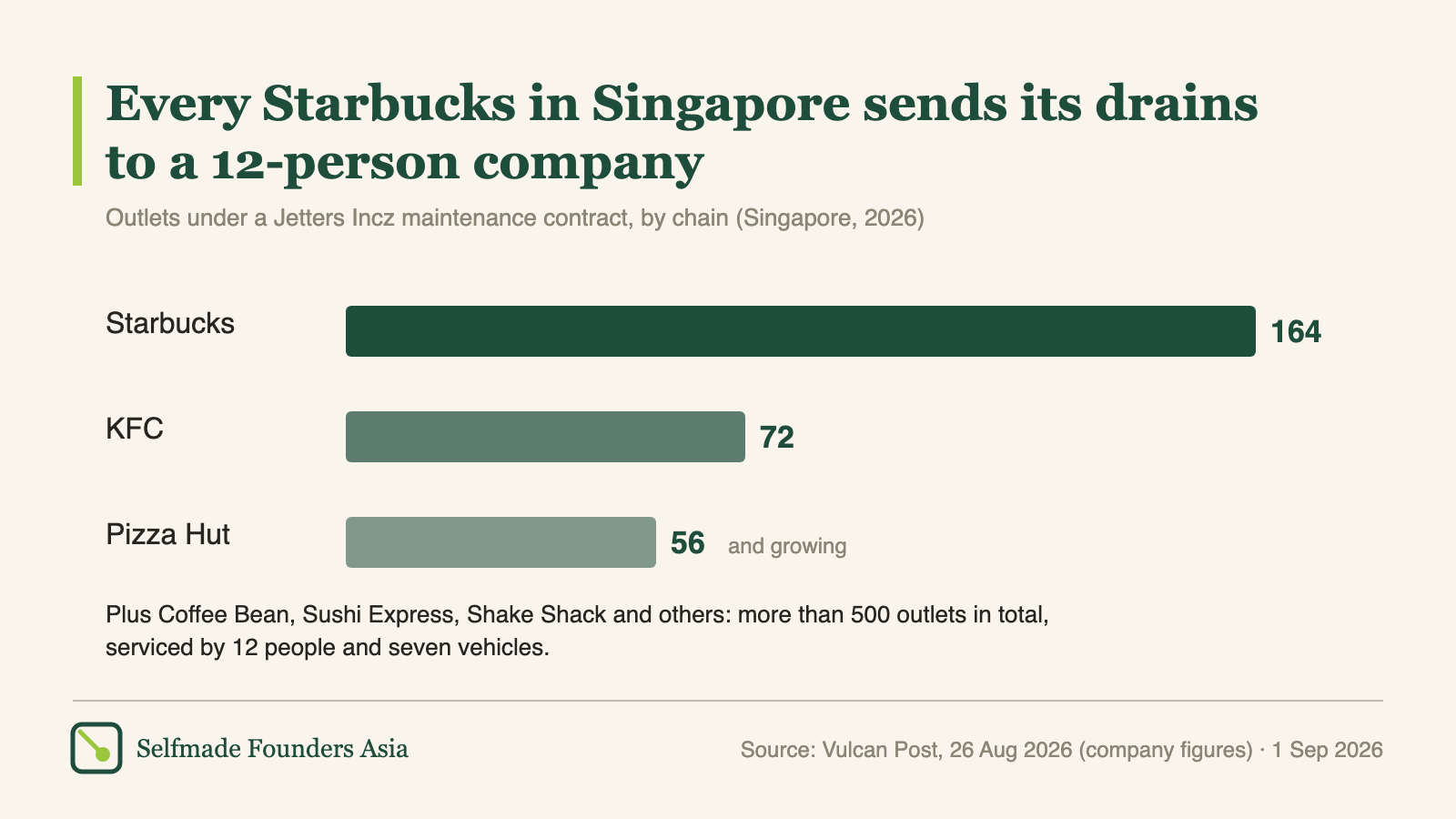
The decision that made the company was about which customer to chase. Early on, Jetters bid for building-maintenance tenders like everyone else and lost to operators with 15-year reputations and lower quotes. So he stopped competing on price and went after chains, brands with dozens of outlets that need the same standard everywhere. Today Jetters maintains the drainage for all 164 Starbucks outlets in Singapore, 72 KFCs and 56 Pizza Huts and counting, alongside Coffee Bean, Sushi Express and Shake Shack, more than 500 outlets in all. "When you can maintain chain outlets well, they stay with you without even doubting you," he says. "That's the epitome of your service quality."
The risks are the ones nobody warns a tradesman about. Payment terms run at least 60 days and can stretch to 200, and when a client folds the money tends to vanish with it: Jetters is still owed for work done for Fatburger, closed in 2023, and Sentosa's Tipsy Unicorn, closed this year. Running costs are around S$200,000 a month.
Since March he has been teaching himself to build an internal AI tool, Shika, to capture what the trade's ageing veterans know and nobody has written down. He has turned down venture capital, private equity and an offer to move the business to the United States, and is in early talks with institutional partners, including GIC, about a technology arm. In 2025 the company came in just under its S$3 million revenue target. "Aimed for the moon and landed on the stars," he says, and expects 2026 to clear it.
The takeaway
- The trade is the moat. Nine years of reading blockages, not a diploma, is what a backer funded on a handshake and what clients followed across companies.
- Choose the customer who pays for consistency. Tenders reward the cheapest bid; chains reward the operator who is the same at outlet 164 as at outlet one.
- In a service business, receivables are the risk. On 60 to 200-day terms, a client's collapse is your loss. Price and plan for it.
🌏 Around the Region
- Singapore: Chelsea Chan's first candy livestream on Shopee, from her family home in May 2022, brought about 10 orders. Candy Cottage now streams six days a week with a team of eight, mostly family, stocks around 500 varieties and packs 150 to 200 orders on an ordinary day. Vulcan Post (August 2026).
- Korea: Three former NEOWIZ investment staff opened Red Brick House in June, a nine-person publisher for PC and console indie games, with about ₩10 billion raised and four titles signed at launch. "It took us three weeks just to decide on the name," the co-CEOs told Inven Global (August 2026).
- Philippines: Meynardo Carpio Jr. started Hinam-Is Delights as a home baking operation in 2008, moved to manufacturing during Covid and incorporated in 2025; the products are now in more than 400 locations nationwide, per a Philstar column (July 2026).
- Thailand: More than 20,000 athletes came to Bangkok in August for the largest HYROX race Asia has held, up from roughly 17,500 in March. AirAsia now partners with local HYROX Training Club gyms: a neighbourhood gym inside an airline's offer. Vulcan Post (August 2026).
Last week: a Singaporean who doesn't speak Japanese opened a ryokan in Toyama. The full archive is at founders.selfmademodal.com.
Forwarded this by a friend? Subscribe here. Found it useful? Forward it to one person who'd want it.
Know a builder who deserves the spotlight? Tell us, reply to this email.
— The Editorial Team