No one came to their basement shop. They built a billion-baht label anyway
Three Bangkok accountants started Gentlewoman in a basement with no investors, kept launching through Covid, and now open in Singapore.


A 6-minute read.
In June 2018 three accounting graduates with no fashion experience opened a clothes shop in a Bangkok basement, across from a busy cosmetics store they hoped would send customers their way. "In the first few months, no one came," one of them remembers. Next month their label, Gentlewoman, opens its first store in Singapore.
🎬 The Story
| Founder | Raya Wannapinyo, Jitpon Siriwattanamathangkul and Siripa Rueangwutthisakulchai |
| Location | Bangkok, Thailand |
| Started | June 2018, with a shop on the basement floor of Siam Square One |
| Bootstrapped? | Yes. "When we started small, we didn't have investors," co-founder Jitpon told Inside Retail Asia in 2024 |
| Revenue (source) | 2,067 million baht in 2024, from company filings — Longtungirl, May 2025 |
Facts below come from Inside Retail Asia (3 September 2024), Forbes Thailand (18 March 2025) and the Bangkok Post (13 March 2025), unless noted. Revenue figures come from the company's annual filings as published by Brand Case and Longtungirl.
Raya Wannapinyo studied accounting at Chulalongkorn University and went into audit. She is petite and struggled to find office clothes that fit, so she started making her own. Friends asked to buy them. The side business grew until, she told Forbes Thailand, it earned about what a new graduate's salary would. Jitpon Siriwattanamathangkul and Siripa Rueangwutthisakulchai, meanwhile, ran pop-up markets that gathered online shops into booths outside shopping centres. The three decided a brand of their own had further to go than either business. Clothing, Jitpon told Inside Retail Asia, was something they loved, and it felt like the smaller risk.
The first shop was on the B1 floor of Siam Square One, opposite the cosmetics chain Eveandboy. "People were going to the large cosmetic store intentionally and might walk past us, but it's not a location with good circulation," Jitpon said. "As a new brand, you can't be in a stand-alone location without traffic and hope for the best." They spent heavily on advertising, and customers picked up once the range moved from workwear to casual clothes.
Sales were about 65 million baht in 2019. Then Covid-19 closed every one of the brand's physical stores, roughly a year and a half after launch, the Bangkok Post reports. "During Covid-19, big brands [were] advised to save money and do nothing. They had the cash to wait it out, but small brands like ours didn't," Jitpon said. "Maybe we could last six months, but eventually, we'd run out of money." So they did the opposite of waiting: new products, online sales, anything that would move. Headbands and beach towels sold while people stayed home, and the casual, logo-led pieces made the name familiar. "Even though our voice wasn't loud, the absence of other voices made us stand out."
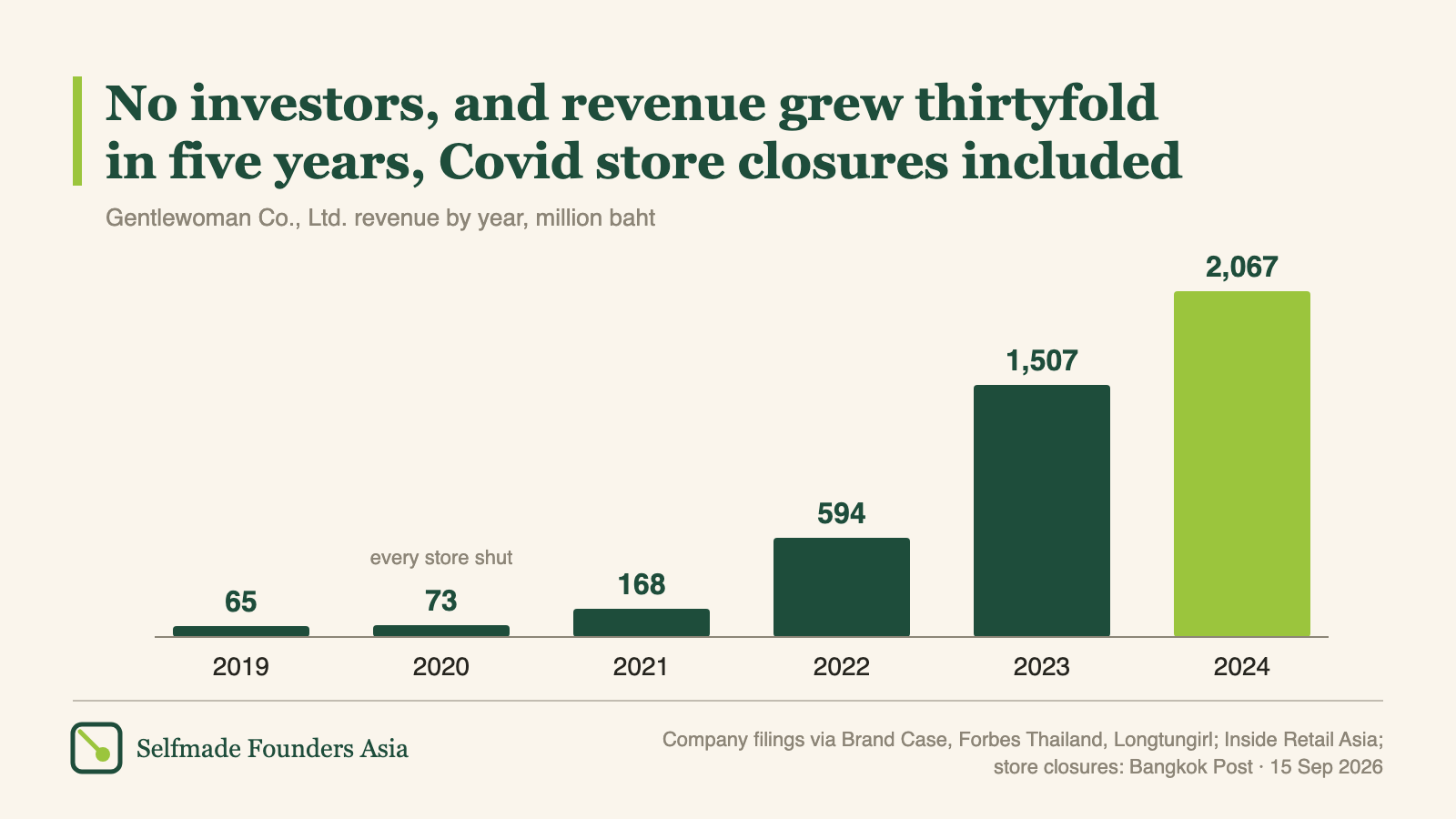
The canvas tote with GENTLEWOMAN printed across it in capitals became the calling card. Revenue reached 168 million baht in 2021 and 594 million in 2022, the year the first flagship opened in Siam Square. At the end of 2022 they started marketing in Singapore, rather than wait for tourists to come back to Bangkok. In 2023 revenue passed 1.5 billion baht.
What keeps customers returning is a weekly release, made in limited runs. The more branches they open, Raya told Forbes Thailand, the more each visit needs something new, or nothing brings the customer back. Designers work from the sales data as well as their taste. By early 2025 the team was more than 200 people, not counting shop staff.
Overseas stores took longer. "As a small team with no investors, we aren't able to do it on our own," Jitpon said in 2024. This year they arrived: Malaysia in January, Indonesia in April and a second Indonesian store in August, per AsiaOne, with Singapore's 313@somerset next in October. The brand has nearly 30 stores in Thailand. It lands in a city where, TheSmartLocal notes, the hype "isn't as pronounced as it used to be".
The takeaway
- Near a crowd is not in its path. Opposite a busy store looked like free traffic. People walked past on purpose, and the basement taught them that circulation decides a location.
- When the big players go quiet, a small voice carries. They could not afford to wait out 2020, so they kept launching, and got heard because few others were talking.
- Newness is the reason to come back. Small weekly drops turn a shop into a habit, which matters more with every store you open.
🌏 Around the Region
- Australia: Singaporean Jameson Wong moved to Melbourne in late 2022 and, one winter night in July 2023, costed out importing mee pok instead of ordering an A$30 delivery. Singapore Hawker Haven now puts flash-frozen laksa, mee pok and fishballs made to Singapore hawkers' recipes into more than 80 Australian stores, reached Los Angeles in June and has been profitable since 2024, its first year, per Vulcan Post (11 September 2026).
- Singapore: Danelle Woo closed her label Aijek in 2019, which at its height made nearly S$4 million a year, to spend more time with her son. She relaunches it on 24 September in plant fibres only, after burying nine fabric samples in her father's garden to see which ones the soil would take back, reports VnExpress International (14 September 2026).
- Thailand and Vietnam: Heavy Pop, a Vietnamese curator with no shops of its own, has space in Bangkok's Siam Discovery through September for Hanoi and Ho Chi Minh City streetwear labels including Stressmama, DirtyCoins and Hades, per Inside Retail Asia (15 September 2026). The idea is to put small brands in front of customers they cannot reach alone.
- Hong Kong: Sparkling-tea brand Saicho, co-founded by Natalie Chiu and Charlie Winkworth-Smith, has opened its first travel-retail site at Hong Kong International Airport, with a tasting bar. "It was never a market we expanded into," Chiu told Inside Retail Asia (7 September 2026).
Last week: two Singapore jewellers who were nervous about charging S$3,000. The full archive is at founders.selfmademodal.com.
Forwarded this by a friend? Subscribe here. Found it useful? Forward it to one person who'd want it.
Know a builder who deserves the spotlight? Tell us, reply to this email.
— The Editorial Team